Raw material quality
Mycotoxins in animal feed: control from the corn lot to the finished feed
Vietnam's legal limits, how to sample so the result means something, and how to read a binder's data before you buy.
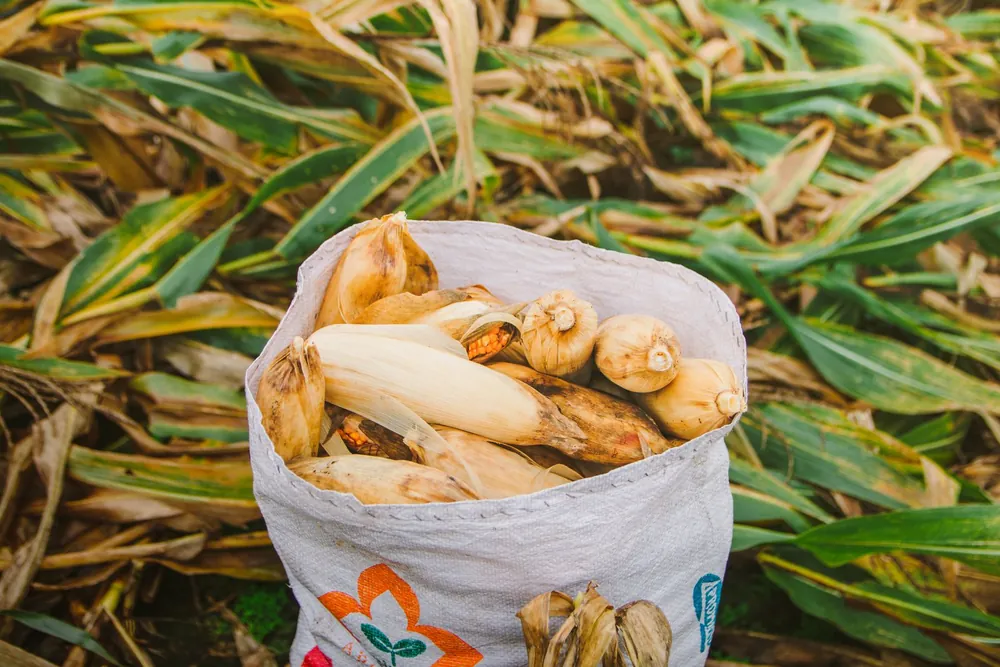
Mycotoxins are toxins produced by Aspergillus, Fusarium and Penicillium moulds on corn, oilseed meals and bran, in the field and in storage. In compound feed, Vietnam limits total aflatoxin to 30 µg/kg for piglets and chicks and 100 µg/kg for other pigs. Control starts with sampling each lot properly; a binder is the last line of defence.
- Pelleting heat does not destroy mycotoxins. A contaminated lot makes contaminated feed.
- Most of the error sits in sampling, not in the lab instrument.
- The regulation only limits aflatoxin, but in pigs DON and ZEN often cost more.
- A binding figure means little unless it states the pH, the challenge level and the binder ratio.
Contents
Why is the mycotoxin risk high in Vietnamese feed?
A hot, humid climate all year and a long corn supply chain. Aspergillus grows fast once grain moisture passes about 14% and temperature passes 25°C, which is normal in warehouses in both the north and the south.
In 2025 Vietnam imported about 11.9 million tonnes of corn, mostly from Argentina and Brazil [1]. The grain spends over a month at sea, then sits at the port and the mill. Every time it sweats from a temperature swing, mould gets another chance. Domestic corn is no safer: a survey of 2,370 maize samples in six provinces found 29% above 5 µg/kg of aflatoxin B1 [2].
Visible mould and mycotoxins are separate questions. Clean-looking grain can carry toxin, and mouldy grain isn't always over the limit. Only an analysis answers it.
Which five toxins should you monitor, and what do they do to pigs and poultry?
Five toxins account for most of the risk in pig and poultry rations. They usually turn up together in one sample, so the real effect can be larger than any one of them alone.
| Toxin | Mould | Typical raw materials | Most sensitive animals | Main effect |
|---|---|---|---|---|
| Aflatoxin (B1) | Aspergillus | Corn, peanut meal, cottonseed meal | Ducks, chicks, piglets | Liver damage, slower growth, residues in milk and eggs |
| Deoxynivalenol (DON) | Fusarium | Corn, wheat, DDGS | Pigs | Feed refusal, lower intake, slower growth |
| Zearalenone (ZEN) | Fusarium | Corn, DDGS | Gilts, sows | Reproductive disorders from its oestrogen-like action |
| Fumonisins (FB1, FB2) | Fusarium | Corn and corn products | Pigs, horses | Lung damage in pigs, poorer feed efficiency |
| Ochratoxin A (OTA) | Aspergillus, Penicillium | Long-stored cereals, bran | Pigs, poultry | Kidney damage, slower growth |
What are the legal limits in Vietnam?
QCVN 01-183:2016/BNNPTNT limits total aflatoxin (B1, B2, G1, G2) in compound and concentrate feed [3]. Corn as a raw material has its own aflatoxin B1 limit in QCVN 01-190:2020 [4].
| Product, animal | Limit |
|---|---|
| Complete feed, piglets (up to 45 days or 15 kg) | 30 µg/kg |
| Complete feed, other pigs | 100 µg/kg |
| Complete feed, chicks and quail chicks (up to 28 days) | 30 µg/kg |
| Complete feed, other chickens and quail | 50 µg/kg |
| Complete feed, ducklings / other ducks | 20 / 50 µg/kg |
| Concentrate for pigs, chickens, quail | 30 µg/kg |
| Corn and corn products (aflatoxin B1) | 50 µg/kg |
The regulation sets no binding limits for DON, ZEN, fumonisins or OTA. Many mills use the EU guidance values as internal limits: for pigs, DON 0.9 mg/kg, ZEN 0.1 mg/kg for piglets and gilts, fumonisins 5 mg/kg and OTA 0.05 mg/kg in complete feed [5].
One point that's often missed: corn at 50 µg/kg, exactly at the raw-material limit, making up 60% of the ration already puts 30 µg/kg into the feed. That's the piglet-feed limit, before soybean meal and rice bran are counted. Set your intake limit by working back from the most sensitive feed you make.
How do you sample and test so the result can be trusted?
Mycotoxins are not spread evenly: a few heavily infected kernels are scattered through the lot. A handful from the top of one bag can read zero while the lot is over the limit, or the other way round.
- Take many small samples
from different points and depths of the truck, barge or silo, following TCVN 4325:2007 (ISO 6497) [6]. For moving grain, sample at regular time intervals.
- Combine them into one aggregate sample
divide it, then grind the whole divided portion fine before weighing out the test portion.
- Screen every truck
with rapid strips or ELISA. Send to a designated lab for HPLC or LC-MS/MS when the result is close to the limit or you need a record.
- Log results by lot and by supplier
After a few months you'll see which suppliers and seasons carry more risk, and your binder inclusion will have a basis.
Keep a retained sample of every incoming lot at least until the last feed made from it has been used. When a farm complains, the retained sample is your only evidence.
Have raw-material test results?
Send us results from your last few lots. We'll suggest an inclusion rate for your actual risk, not the brochure's.
How do mycotoxin binders work?
A binder holds the toxin in the gut so it leaves in the manure instead of being absorbed into the blood. No single material binds every toxin well, because each toxin has a different molecular structure.
- Clays (bentonite, zeolite, clinoptilolite) bind aflatoxin well, a flat, polar molecule. They do little against DON and ZEN.
- Yeast cell wall (esterified glucomannan) widens the range to ZEN and part of the other toxins.
- Enzymes and degrading microbes convert DON, ZEN and fumonisins into less toxic compounds instead of binding them.
So a product for pig feed should combine two or more mechanisms. A binder also doesn't replace rejecting an over-limit lot: it lowers how much toxin the animal absorbs, not the level measured in the feed.
How do you read a binder supplier's data?
Most figures come from in-vitro tests: binder and toxin mixed in solution, then the bound share measured. "100%" only means something next to the test conditions. Ask the supplier these five questions.
| Question | Why it matters |
|---|---|
| At what pH? | The stomach is around pH 3, the small intestine pH 6–7. A binder that holds at pH 3 but releases at pH 7 is worth little. |
| At what challenge level? | Binding 100% of a very low dose is far easier than binding the levels found in a badly contaminated lot. |
| At what binder ratio? | A ratio higher than your real inclusion in feed makes the result look better than practice. |
| Which lab, which year? | Independent, dated data is worth more than a table in a brochure. |
| Was it tested in animals? | In-vivo results (growth, liver markers, residues) are stronger evidence than in-vitro. |
As an example from our own range, MINGFIX combines activated clinoptilolite with esterified glucomannan. The manufacturer's data shows in-vitro binding of 100% for aflatoxin B1 at a 3.5 ppm challenge and 80% for DON at 7.0 ppm. An independent in-vitro test at North Carolina State University (2003) recorded 87.0% aflatoxin B1 binding against 3.8% for a comparison product under the same conditions. That data is old and in vitro; we say so, and the original documents are in our evidence library.
Our view
- Test first, then dose. Base the inclusion rate on lot results and season, not one fixed rate all year.
- Reject or divert over-limit lots to less sensitive feeds where the law allows. A binder does not turn a failed lot into a passing one.
- For pig feed, look beyond aflatoxin. Add DON and ZEN to the test plan, and choose a product with two or more mechanisms.
- Judge it in your own trial: one line, one inclusion rate, your own records. See how to set it up in the guide to feed without preventive antibiotics.
FAQ
Does pelleting at 80–90°C destroy mycotoxins?
Not to any useful degree. Aflatoxin, DON, ZEN and fumonisins are heat-stable at normal pelleting temperatures. Heat kills the mould, but the toxin it has already produced stays in the feed.
Can a binder bring an over-limit batch back into compliance?
No. A binder works in the animal's gut. It does not lower the toxin level measured in a feed sample, so a batch above the regulatory limit is still above the limit.
Can rapid test strips replace HPLC?
Strips or ELISA kits are right for screening every truck. When a result is close to the limit, when there is a dispute with a supplier, or when you need a record, send the sample to a designated lab for HPLC or LC-MS/MS.
Do binders also hold back vitamins, minerals or veterinary drugs?
Some clays can bind part of the trace minerals and some active substances. Ask the supplier for nutrient-binding data, and talk to your veterinarian when the ration carries prescribed medication.
Which mycotoxins should we test in a corn lot?
Aflatoxin at minimum, because it is the regulated one. For pig feed, add DON and ZEN; for corn from regions with rain at harvest, add fumonisins. The toxins usually occur together, so a multi-toxin panel for every new supplier makes sense.
Sources
- Vietnam Customs, preliminary 2025 corn import data: 11.91 million tonnes (reported by Báo Nghệ An, Jan 2026).
- Lee H.S., Nguyen-Viet H., Lindahl J. et al. (2017). A survey of aflatoxin B1 in maize and awareness of aflatoxins in Vietnam. World Mycotoxin Journal 10(2): 195–202. 2,370 samples, six provinces; 28.98% above 5 µg/kg (ELISA).
- QCVN 01-183:2016/BNNPTNT, Table 1: maximum total aflatoxin (Circular 27/2016/TT-BNNPTNT).
- QCVN 01-190:2020/BNNPTNT, Annex I: corn and corn products, aflatoxin B1 50 µg/kg.
- European Commission Recommendation 2006/576/EC on DON, ZEN, OTA and fumonisins in animal feed.
- TCVN 4325:2007 (ISO 6497:2002), Animal feeding stuffs: sampling.
Technical information, not a substitute for veterinary advice. Biofeed Ras products are feed additives, not veterinary drugs.